
Win the first two yards and the route belongs to you. Lose the first two yards and now you are fighting uphill, late to the break-point, and begging the quarterback to throw you open.
That is why your “wide receiver stance and start” matter.
A receiver does not beat coverage only at the top of the route. He starts beating it before the snap, before the first step, before the corner even gets his hands on him.
Look.
The line of scrimmage is a fight.
It is not a place to stand casually. It is not a place to look pretty. It is where your body language, foot pressure, release angle, hand timing, and first burst tell the defensive back whether you are dangerous or easy work.
If your stance is dead, your release is late.
If your release is late, your stem is weak.
If your stem is weak, your break has no violence.
Then everybody blames the quarterback.
Wrong answer.
Fix the start.
Why The First Two Yards Control The Entire Route
Most young receivers think separation happens at the break.
Sometimes it does.
But against good coverage, separation starts earlier.
It starts with your stance.
Then your first step.
Then your release angle.
Then the way you attack leverage.
Then your ability to make the defender open his hips before you declare the route.
The first two yards decide whether the defensive back is comfortable.
That is the whole game.
Make him comfortable and he sits on you.
Make him uncomfortable and now he has to guess.
That is when you win.
What A Great WR Start Must Accomplish
A clean wide receiver stance and start should do five things:
| Start Skill | What It Means | Why It Matters |
| Balance | Body loaded without leaning too far | Prevents false steps |
| Forward Pressure | Weight ready to push off the front foot | Builds linear acceleration |
| Low Pad Level | Chest over knees through early steps | Improves burst and control |
| Clean Arm Drive | Violent elbow action | Creates speed and rhythm |
| Release Direction | First steps attack leverage | Helps defeat press-man and off coverage |
Here’s the deal.
You do not need 20 release moves.
You need a stance that does not lie, a first step that does not waste time, and a release that makes the corner wrong.
That is where this article lives.
What Your Stance Says About You
Before the ball is snapped, the defensive back is reading you.
Do not think he is not.
Corners watch your feet. They watch your shoulders. They watch your eyes. They watch whether your weight is loaded or lazy.
Your stance gives away information.
Sometimes it gives away the whole route.
The Lazy Stance
This is the receiver standing tall, feet flat, hands hanging, chest upright.
It says one thing.
“I am not threatening you.”
A defensive back sees this and feels safe. He can squat. He can press. He can sit inside. He can jump the quick route.
You gave him permission.
The Overloaded Stance
This receiver leans too far forward.
His helmet is almost past his toes.
He thinks he looks explosive.
He actually looks unstable.
The result?
False step.
Stumble.
Early balance loss.
A smart corner sees that and attacks the chest because he knows the receiver cannot redirect cleanly.
The Route-Tell Stance
Some receivers change stance depending on the route.
On a fade, they lean forward.
On a hitch, they sit back.
On a slant, they cheat their inside foot.
On a screen, they look soft.
Bad habit.
Defenders notice patterns.
Film does not lie.
The Loaded Stance

This is what you want.
Feet slightly staggered.
Weight on the front half of the feet.
Knees bent.
Chest over thighs.
Back flat enough to stay balanced.
Eyes calm.
Hands loose but ready.
This stance says, “I can go anywhere.”
That is the goal.
The Coach’s Whistle
- Do not tell him the route!
- Same stance every snap!
- Loaded, not leaning!
- Be dangerous before the ball moves!
- No lazy feet!
Common Mistakes
Mistake #1: Changing Stance By Route
Young receivers think they are being comfortable.
They are actually tipping plays.
Fix
Use the same stance for quick game, vertical routes, screens, and run plays.
Same body language.
Every snap.
Mistake #2: Flat Feet
Flat feet kill explosions.
Fix
Keep pressure through the balls of the feet.
Not on the toes.
Not on the heels.
Loaded in the middle-front.
Mistake #3: Eyes Wandering
Some receivers look at the safety, the sideline, the quarterback, then back to the ball.
The corner sees panic.
Fix
Keep your eyes calm.
Know the coverage before you settle into the stance.
Solo Modification
Set up your phone facing you from the defensive back’s angle.
Take 10 stances.
Do not run.
Just line up.
Watch the video and ask one question:
“Can the corner guess what I am doing?”
If yes, fix it.
Drill #1: Release Angle Drill

Primary Focus
- Linear acceleration
- Release angles
- Footwork
- Press-man escape
- First-step violence
The release angle drill teaches you how to win space without wasting steps.
A lot of young receivers dance at the line of scrimmage.
They shake.
They hope.
They tap their feet.
The corner does not move.
That is not a release.
That is panic with rhythm.
A release should create an angle, protect your route stem, and get you back vertical fast.
Setup
Equipment:
- 3 cones
- Football optional
- Resistance band optional
Place one cone at the line of scrimmage.
Place one cone 3 yards upfield and slightly inside.
Place one cone 3 yards upfield and slightly outside.
The inside cone represents an inside release.
The outside cone represents an outside release.
You are training both.
How To Perform The Drill
1. Start in your normal wide receiver stance.
2. Identify the release angle before the rep.
3. On command, take one hard jab opposite the release.
4. Use a violent arm action through the imaginary defender’s frame.
5. Drive off the plant foot.
6. Burst through the chosen cone.
7. Stack back vertical after clearing the release angle.
8. Finish 8 to 10 yards downfield.
9. Reset and repeat on the opposite side.
Run 4 sets of 4 reps each direction.
Do not rush the setup.
The stance must be clean before the release starts.
Why This Drill Works
Press-man coverage is about leverage.
If the defensive back has inside leverage, he wants to protect the slant, dig, glance, or inside stem.
If he has outside leverage, he wants to squeeze you toward help, boundary, or safety structure.
Your release angle is how you attack that leverage.
You are not just trying to run around him.
You are trying to make him open the wrong gate.
The Coach’s Whistle
- Do not dance!
- Win the angle!
- Step on his toes!
- Hands through the frame!
- Stack him now!
Common Mistakes
Mistake #1: Too Many Steps At The Line
Young receivers love extra movement.
Two jabs.
Three foot taps.
Shoulder shake.
Head fake.
Still standing there.
The route is dead.
Fix
Limit the release.
One jab.
One win step.
Go.
If the move does not help you gain ground, it does not belong.
Mistake #2: Running Sideways
A release angle is not a sideline sprint.
Receivers often escape wide, then never return to the route stem.
The quarterback expects you in one window.
You show up in another.
Bad ball.
Bad rep.
Bad film.
Fix
Your second step must gain vertical grass.
Even when releasing outside, you still need to attack upfield.
Mistake #3: Weak Hands
Some receivers let the corner touch first.
Wrong.
If a press corner gets clean hands on your chest, your route timing is already bleeding.
Fix
Use your hands with purpose.
Swipe.
Rip.
Club.
Clear the frame and accelerate.
Solo Modification
Use a cone, bag, or backpack as the press defender.
Place it directly in front of your alignment.
Work inside and outside release angles.
After every rep, check whether you returned vertical within three steps.
If you kept drifting, the rep does not count.
Drill #2: Diamond Release Drill
Primary Focus
- Press-man footwork
- Cover 1 release mechanics
- Route deception
- Hip and shoulder selling
- Acceleration after the fake
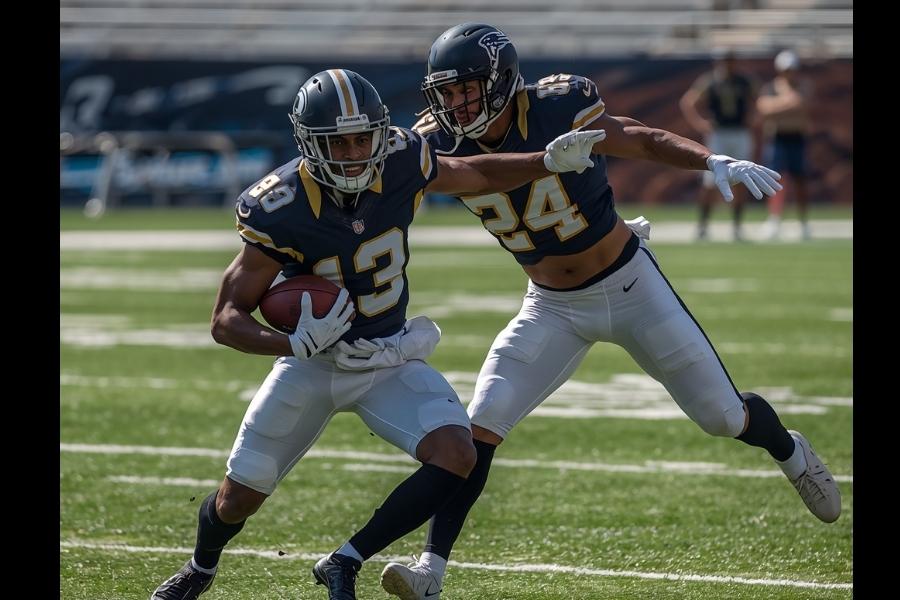
The diamond release drill teaches you how to sell one direction and win another.
This matters against press-man, especially when the corner is patient.
Some defensive backs do not lunge.
They wait.
They mirror.
They sit square.
Against that type of defender, your release has to threaten his leverage with your full body.
Not just your feet.
Your hips.
Your shoulders.
Your eyes.
Everything sells.
Setup
Equipment:
- 4 cones
- Football optional
- Partner optional
Create a diamond shape:
| Cone | Placement |
| Cone 1 | Starting point on line of scrimmage |
| Cone 2 | Two yards inside |
| Cone 3 | Four yards upfield |
| Cone 4 | Two yards outside |
You can reverse the diamond depending on the route.
Use one side for an inside fake to outside release.
Use the other side for an outside fake to inside release.
How To Perform The Drill
1. Start at Cone 1 in the receiver stance.
2. Jab hard toward Cone 2.
3. Sell the fake with shoulders and hips.
4. Push vertically toward Cone 3.
5. Snap toward Cone 4.
6. Burst upfield after the angle change.
7. Finish with a 5-yard acceleration.
8. Add a catch if a quarterback or coach is available.
Run 3 to 4 sets each direction.
Every rep must have a body sold.
No lazy fakes.
Why This Drill Works
Diamond releases train a receiver to manipulate the defensive back’s center of gravity.
When you sell inside, the corner shifts his weight.
When he shifts weight, his hips become vulnerable.
When his hips become vulnerable, you take the opposite angle.
The result?
Separation before the route even begins.
This is especially useful on:
- Slants
- Fades
- Speed outs
- Glance routes
- Slot fades
- Whips
- Return routes
Against Cover 1, the defender often has man responsibility with help somewhere else.
Your job is to understand his leverage and attack it.
The Coach’s Whistle
- Sell it with your body!
- Move his hips!
- Do not fake with dead shoulders!
- Snap back now!
- Burst out!
Common Mistakes
Mistake #1: Fake Only With The Feet
A foot jab without shoulder movement does not scare anybody.
The corner watches your torso.
If your chest does not sell the fake, he stays patient.
Fix
Point your sternum toward the fake for one violent step.
Make the defender believe.
Mistake #2: Floating Through The Diamond
Some receivers run the diamond like a curved path.
That defeats the purpose.
Fix
Hit the angles sharply.
Each cone is a decision point.
Not a suggestion.
Mistake #3: No Acceleration After The Fake
A release is only useful if it creates speed into the route.
Some players win the fake, then jog out.
That lets the corner recover.
Fix
After the final angle, burst vertically.
Three hard steps.
Minimum.
Solo Modification
Set the diamond with cones and run it without a partner.
After the final cone, sprint 5 yards.
Film from the front.
Watch your shoulders.
If your upper body stays square during the fake, you did not sell it.
Redo the rep.
Drill #3: Motor Release Drill
Primary Focus
- Timing
- Release rhythm
- Release angles
- Press-man patience
- First-step decision-making
The Motor Release Drill teaches controlled chaos.
Some receivers hear “release” and immediately rush.
They panic.
They throw their feet everywhere.
They move fast but gain no ground.
A motor release is different.
It keeps your feet alive while your body stays under control. You are not stuck. You are not frozen. You are ready to attack when the defender declares.
This drill is built for receivers who face patient press corners.
Setup
Equipment:
- 1 cone for line of scrimmage
- 2 angle cones
- Optional partner as defensive back
- Optional football
Place one cone at the start.
Place two cones 3 to 4 yards upfield:
One inside
One outside
A partner can stand directly in front of the receiver.
If solo, use a cone or bag as the defender.
—
How To Perform The Drill
1. Start in the receiver stance.
2. On command, begin light motor feet in place.
3. Keep feet active without bouncing high.
4. Stay low.
5. Coach points inside or outside.
6. The receiver immediately attacks that release angle.
7. Use your hands through the imaginary defender.
8. Burst through the cone.
9. Stack vertical.
10. Finish 8 to 10 yards downfield.
If using a partner, the defender gives slight leverage.
The receiver must react.
No guesses.
Why This Drill Works
Motor feet help receivers avoid becoming statues against the press.
But there is a danger.
Too much motor becomes wasted movement.
The goal is active readiness.
Not tap dancing.
This drill trains the receiver to stay loaded while waiting for the right release angle.
It also connects eyes, feet, and hands.
That matters.
Against a real defensive back, you do not always get the exact release you planned. Sometimes he shades late. Sometimes he jumps inside. Sometimes he sits heavily outside.
You need answers.
The Coach’s Whistle
- Active, not wild!
- Stay loaded!
- Do not bounce!
- React now!
- Win vertically!
Common Mistakes
Mistake #1: Bouncing Too High
Receivers start hopping.
Now their center of gravity rises.
That makes the release slow.
Fix
Keep motor feet low to the ground.
Cleats barely leave the turf.
Mistake #2: Moving Without A Plan
Fast feet with no angle is wasted energy.
Fix
Motor feet must lead into a release.
Inside or outside.
No neutral reps.
—
Mistake #3: Letting Hands Die
Receivers get so focused on foot rhythm that they forget hand combat.
A press corner will not.
Fix
Pair the release step with a hand action.
Foot and hand together.
Solo Modification
Use a phone timer or audio cue.
Set two cones for release angles.
Start motor feet.
When the timer beeps, choose a release angle and explode.
Alternate directions each rep.
If you have a resistance band, attach it safely behind you and work low motor feet into acceleration.
Drill #4: Stem and Leverage Drill
Primary Focus
- Route stem
- Deciphering coverages
- Defender leverage
- Route manipulation
- Spatial awareness
The stem is where smart receivers steal space.
Bad receivers run directly to the route.
Good receivers run at the defender first.
That sounds simple.
It is not.
The route stem is the vertical path you take before the break-point. It controls how the defensive back moves, opens his hips, protects leverage, and reacts to your break.
If you never threaten leverage, the defender never feels stressed.
He just waits.
Then he breaks up with you.
No separation.
Setup
Equipment:
- 2 cones
- Optional third cone as defender
- Football optional
Place one cone at the line of scrimmage.
Place one cone 10 to 12 yards downfield as the break-point.
Place a defender cone slightly inside or outside the route path.
That defender cone represents leverage.
How To Perform The Drill
1. Align at the line of scrimmage.
2. Identify defender leverage before the rep.
3. Release vertically.
4. Stem toward the defender’s leverage.
5. Force the defender to protect that space.
6. Hold the stem long enough to make him react.
7. Break away from leverage.
8. Burst out of the break.
9. Finish with a catch or 5-yard acceleration.
Run this drill with different route types:
- Dig
- Out
- Curl
- Comeback
- Post
- Corner
- Slant
Do not run them all the same.
That is the point.
Understanding Leverage
A defensive back rarely lines up randomly.
His alignment tells you what he wants to protect.
| Defender Look | What It Usually Means | Receiver Response |
| Inside leverage his face | Protecting inside routes | Attack inside shoulder, break away or cross |
| Outside leverage | Protecting sideline or outside release | Stem outside, create room inside |
| Head-up press | Wants to mirror | Use release angle and hands |
| Off-man | Protecting vertical speed | Eat cushion, threaten deep |
| Zone | Defending space | Find grass, settle in window |
Listen.
Do not memorize this like a classroom chart.
Feel it on the field.
Line up. See leverage. Attack leverage.
Coverages And Stem Decisions
Against Cover 1
Cover 1 usually means man coverage with a single high safety.
You must beat your man.
Your stem should threaten the defender’s leverage and create body separation.
No lazy breaks.
No soft top of route.
Against Cover 2
Cover 2 usually gives you a corner in the flat and safety over top.
Your release and stem must respect the boundary and hole windows.
Do not run yourself into safety.
Do not widen so much that the sideline becomes another defender.
Against Zone Coverage
Against zone, you are not trying to beat one man the whole route.
You are attacking space.
Your stem should move defenders, open throwing windows, and help the quarterback see your numbers.
The Coach’s Whistle
- Attack leverage!
- Make him wrong!
- Hold the stem!
- Do not declare early!
- Break off his hip!
Common Mistakes
Mistake #1: Running Away From The Defender Too Early
Young receivers think open grass means immediate escape.
But if you run away too early, the defender takes a clean angle.
Fix
Threaten the defender first.
Make him move.
Then break.
Mistake #2: Leaning Before The Break
Receivers often tilt their shoulders toward the route before cutting.
That tells the defensive back what is coming.
Fix
Keep shoulders square through the stem.
Declare late.
Mistake #3: Same Stem Against Every Coverage
A route is not just a drawing on paper.
A 10-yard out against off-man is different from a 10-yard out against Cover 2.
Fix
Call out coverage before each rep.
Then run the route with purpose.
Solo Modification
Use cones to create defender leverage.
Before every rep, say the look out loud:
- Inside leverage.
- Outside leverage.
- Off-man.
- Zone window.
- Cover 2 corners.
Then run the stem.
This trains football awareness, not just footwork.
Drill #5: Full Stance-To-Stem Progression
Primary Focus
- Pre-snap stance
- First-step discipline
- Release mechanics
- Stem control
- Coverage reaction
This section connects everything.
A stance means nothing if the first step is bad.
A release means nothing if the stem is lazy.
A stem means nothing if the break is obvious.
The goal is to build a complete line-of-scrimmage progression.
Start.
Release.
Stem.
Win.
Setup
Equipment:
- 4 cones
- Optional partner
- Football optional
Set cones like this:
| Cone | Purpose |
| Cone 1 | Line of scrimmage |
| Cone 2 | Release angle |
| Cone 3 | Stem landmark |
| Cone 4 | Break-point or finish landmark |
Use different alignments based on the route.
For slant:
- Release cone outside
- Stem landmark vertical
- Break inside
For out:
- Release cone inside or vertical
- Stem landmark at depth
- Break outside
For fade:
- Release cone outside
- Stem landmark red line
- Finish vertical
How To Perform The Drill
1. Begin in a loaded stance.
2. Hold stance for two seconds.
3. On command, fire the first step.
4. Attack chosen release angle.
5. Use hand action through the defender.
6. Stack vertical.
7. Stem toward leverage.
8. Break or finish based on route.
9. Catch if available.
10. Sprint through the finish.
Do not separate the pieces.
The game does not.
The Coach’s Whistle
- Same stance!
- The first step wins!
- Clear the frame!
- Stack vertical!
- The route starts now!
Common Mistakes
Mistake #1: Treating The Release As A Separate Drill
Some receivers win the release, then relax into the stem.
The defender recovers.
Fix
Think of the release as the first part of the route.
Keep accelerating.
Mistake #2: No Stack After Release
If you beat press but stay beside the defensive back, he can squeeze you.
Fix
After clearing him, stack on top.
Put him behind you.
Mistake #3: Getting Too Wide
Receivers sometimes win outside but drift toward the boundary.
The quarterback loses space.
Fix
Win the angle, then return vertical.
Solo Modification
Run the full progression with cones.
Film from behind.
You should see:
- No false step
- Sharp release angle
- Return to vertical
- Controlled stem
- No early lean
If one piece breaks, slow down and rebuild.
The Stance And Start Checklist
Use this before every practice.
| Checkpoint | Question |
| Feet | Am I loaded without leaning? |
| Weight | Am I ready to push forward? |
| Eyes | Do I already know the coverage look? |
| Hands | Are they relaxed but ready? |
| First Step | Am I gaining ground immediately? |
| Release | Am I attacking leverage? |
| Stem | Am I forcing the defender to react? |
Simple checklist.
Hard execution.
15-Minute Stance And Start Workout
This is a fast daily workout for receivers who need better line-of-scrimmage mechanics.
| Time | Drill | Focus |
| 2 min | Stance Holds | Balance and body language |
| 3 min | First-Step Bursts | Linear acceleration |
| 4 min | Release Angle Drill | Inside and outside releases |
| 3 min | Diamond Release Drill | Press-man deception |
| 3 min | Stem and Leverage Drill | Route intelligence |
Keep rest short.
Keep reps clean.
Do not turn technical work into sloppy conditioning.
30-Minute Advanced WR Start Session
Use this for high school varsity, college prep, or position-group training.
| Block | Time | Work |
| Warmup | 5 min | Hip mobility, ankle stiffness, sprint skips |
| Stance | 4 min | Same stance for multiple route calls |
| Releases | 8 min | Release angle and motor release |
| Press Work | 5 min | Diamond release with hand combat |
| Stem Work | 5 min | Leverage-based route stems |
| Finish | 3 min | Stance-to-stem full progression |
Quality matters.
A perfect 30-minute session beats a sloppy 90-minute workout.
Coaching Notes For Youth And High School WRs
Coaches do not overload young receivers.
Do not teach every release move in one day.
Do not scream ten corrections after one rep.
Pick one focus.
Then demand it.
For beginners:
- Start with stance
- Add first step
- Add inside release
- Add outside release
- Add one route stem
- Add coverage recognition later
- Demand same stance every snap
- Train releases weekly
- Add hand combat
- Teach leverage
- Film route stems
- Grade effort and detail
The receiver position rewards detail.
Lazy detail becomes lazy film.
Final Thoughts
- The wide receiver stance and start are not small details.
- They are the beginning of separation.
- They are the beginning of timing.
- They are the beginning of trust.
A quarterback trusts the receiver who is on time. A coach trusts the receiver who does not tip routes. A defensive back fears the receiver who can release either way, attack leverage, and explode into the stem without wasted movement.
That starts before the ball is thrown.
Before the break.
Before the route.
At the line.
So line up.
Same stance.
Loaded feet.
Calm eyes.
Violent first step.
Win the first two yards.
Then go take the route.