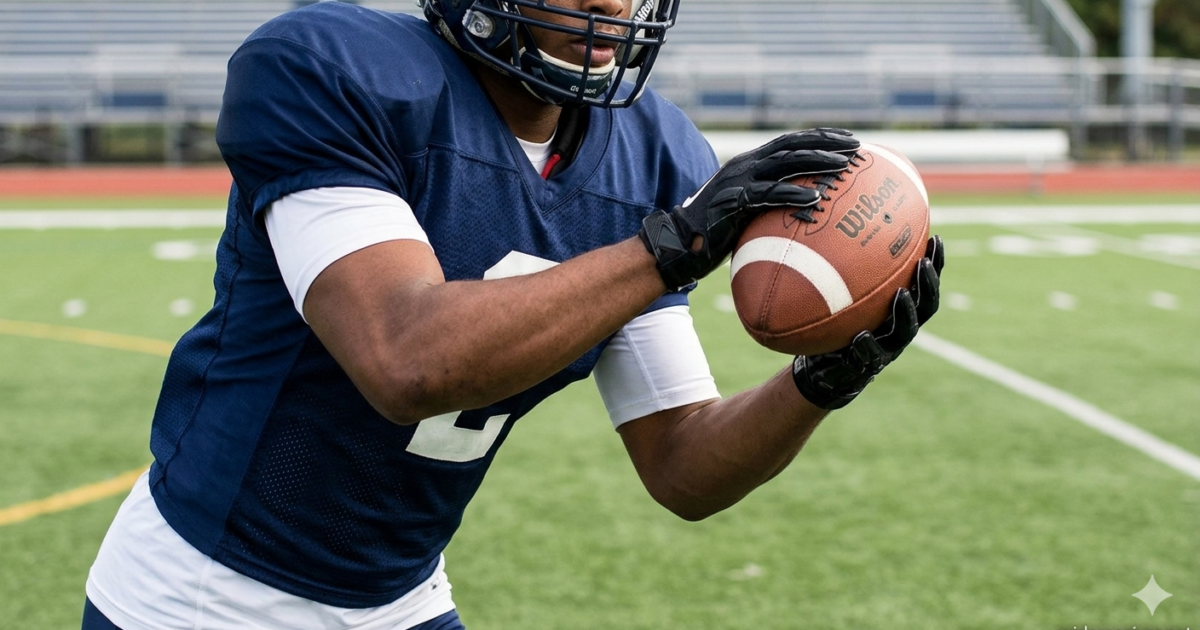
Introduction: The Biomechanical Reality
Hand size is measured at the NFL Scouting Combine by stretching the palm flat and recording the distance from the tip of the pinky to the tip of the thumb. The average measurement for drafted wide receivers hovers around 9.5 inches. But here’s what the number doesn’t tell you: some of the most technically precise pass-catchers in football history have played with hands at or below that threshold.
Steve Smith Sr. played 16 NFL seasons with 9-inch hands. Cole Beasley — one of the most reliable slot receivers of his generation — measured in under 9 inches. Victor Cruz ran one of the most productive stretches in New York Giants history without elite hand size. What these players share isn’t anatomy. It’s architecture.
When you lack surface area, success relies entirely on leverage, friction, and kinetic timing. Raw hand size determines how much of the football you can cover at once. Technique determines whether any of that coverage actually matters. If you’re searching for how to catch a football with small hands, this guide gives you the biomechanical framework — not motivational noise, not workarounds, but the precise mechanical system that makes small hands irrelevant at the point of contact.
Section 1: Maximizing Your Natural Hand Span and Finger Extension
The Anatomy of the Catch — What’s Actually Happening at Impact
Every catch involves a collision. The football arrives at velocity, and your hands must decelerate it, grip it, and secure it — all within a window measured in milliseconds. For receivers with larger hands, a degree of passive coverage compensates for minor errors in positioning. For football catching technique for small hands, there is no such margin. The mechanics must be precise because the anatomy won’t bail you out.
The key anatomical structure is the interosseous muscle group — the small, deep muscles seated between the metacarpal bones of your hand (the long bones running from wrist to knuckle). These muscles control the spreading and closing of the fingers. Most athletes never consciously train them. Elite small-handed receivers learn to weaponize them.
Active Span Training: Stretching the Interosseous Muscles
To maximize hand span in football, you must train active extension — not passive resting width. Here’s how to develop it:
- Finger-spread isometric holds: Place your hand flat on a surface and actively drive each finger away from the center while maintaining contact with the table. Hold for 5 seconds, release. Perform 3 sets of 10 reps per hand daily. This directly loads the interosseous muscles under tension.
- Resistance band finger extensions: Loop a thin resistance band around all five fingers. Spread the fingers against the resistance for 3 sets of 15. This builds the explosive extension capacity you need at the moment of impact.
- Active span measurement: After 4 weeks of consistent training, measure your active hand span with fingers fully extended and spread under conscious effort. Most athletes gain 0.25 to 0.5 inches of functional span — without changing their anatomy.
The “Active Hands” Concept
This is the most critical pre-catch principle for catching a football with short fingers: your hands must stay completely relaxed during the route, through the break, and through the first frame of ball arrival — then explode into full extension at the precise moment of contact.
Rigid, pre-tensed hands reduce your functional span and create a brittle contact surface. A relaxed hand that fires into extension generates more surface area at contact and absorbs the ball’s velocity more effectively. Think of it like a sprinter’s hands — loose until the drive phase demands power. Train this as a deliberate habit. Relaxed in the route. Explosive at the catch point.
Section 2: Hand Formatting for Small Hands — The Diamond vs. The Web
Why the Standard Diamond Fails Small-Handed Receivers
The traditional “diamond” or “triangle” catch — thumbs touching, index fingers pointed toward each other, forming a window to look through — is coached universally because it works for most hand sizes. For a receiver with a 10-inch span, the diamond creates full ball coverage across the nose and upper belly of the football.
For a receiver working on football catching technique for small hands, the diamond creates a specific mechanical problem: the gap. When your thumbs meet but your palms can’t reach the lower belly of the ball, the football wedges into that gap on high-ball catches and rolls through it on medium-trajectory passes. This is the root cause of the double-catch — ball hits thumbs, deflects slightly, receiver recovers. It looks like concentration. It’s actually geometry.
The Web Catch — Wrapping the Nose
The corrective technique is what elite WR coaches call the “Web” or modified nose-wrap catch. Instead of trying to clamp the widest circumference of the football, you shift your hands forward and target the narrower nose of the ball — the forward point — where even a smaller hand span can achieve full, gap-free coverage.
Execution for high balls (above the waist / above the shoulders):
- Hands arrive thumbs-in, pinkies out, slightly staggered rather than perfectly mirrored
- Target contact point: the front one-third of the football, not the center
- At contact, fingers wrap over and around the nose rather than flattening against the belly
- The ball is secured by the fingertips gripping the seams, not the palm pressing the leather
Execution for low balls (below the waist / scoop catches):
- Pinkies together, not thumbs — this is the universal coaching cue, but the modification for small hands is critical here
- Rather than cupping the underside of the ball’s widest point, angle the hands so you contact the back third of the football as it drops, letting the ball roll slightly forward into your palms
- This converts a scoop into a controlled roll-catch, dramatically reducing the chance of a bobble
Execution for body catches (ball arriving at chest/stomach):
- Do not attempt to catch with hands alone — actively trap the ball against the body using the forearms as a secondary catch surface
- Contact hands first, forearms assist immediately; this is not a weakness — it is deliberate technique used by every elite slot receiver in football
Section 3: Absorbing Kinetic Energy — The “Soft Hands” Mechanics
The Physics of Deceleration
A football thrown at 50 mph arrives at your hands carrying significant kinetic energy. A receiver with large hands can generate enough friction and palm-to-leather surface area to absorb that energy through grip force alone. For catching a football with short fingers, the palm coverage isn’t sufficient to stop the ball through clamping. The energy absorption must be distributed across a larger mechanical system — specifically, the wrists and elbows acting as a kinetic chain.
This is the biomechanical basis of “soft hands.” It is not a personality trait. It is a physics solution.
The Pull-Back Technique: Wrists and Elbows as Shock Absorbers
At the moment of contact, the hands must move with the ball rather than against it:
- Wrist action: As fingertips make contact, the wrists flex backward slightly — a 10 to 15-degree yield — decelerating the ball over a longer time window. This is the same principle as a catching mitt in baseball. More time = less peak force = more control.
- Elbow draw: Simultaneously, the elbows pull back toward the rib cage, continuing the deceleration arc. The ball travels with you for 3 to 6 inches post-contact before it is fully secured.
- Eyes through contact: The single most common mechanical error at this phase is the premature tuck — turning the head and body before the hands have secured the catch. Keep your eyes on the ball through the full pull-back arc. The tuck happens after the ball is in your hands, not simultaneously.
Securing the Deep Pass — Body Positioning and the Instant Tuck
The deep ball is where football catching technique for small hands is most severely tested. At maximum velocity, with a cornerback in trail coverage, the margin for mechanical error is essentially zero.
Body positioning protocol for the deep pass:
- Lead with the outside hand when catching over the shoulder — this shields the ball from the defender and gives you an early contact point
- Angle the torso away from the defender before contact — your body becomes a wall between the cornerback and the catch point
- Drive the ball to the rib cage immediately after fingertip contact — do not float the ball in the hands for even one frame; compress it against the body using the forearm as a clamp
- Tuck the near elbow down over the ball as you secure — this is the final lock, trapping the football between your forearm, rib cage, and bicep in a three-point hold that no defender can dislodge with a strip attempt
The pull-back absorption combined with the instant body tuck creates a catch sequence that is mechanically independent of hand size. The hands initiate. The body finishes.
Section 4: Grip Strength and Grip Friction Optimization
Targeted Exercises for Fingertip Leverage
To maximize hand span in football and improve the force your fingertips can generate at the catch point, train the hands specifically — not just generally:
- Plate pinches: Hold a 25 or 35-pound weight plate between your thumb and four fingers for 20 to 30-second holds. This builds the precise fingertip-to-palm compression force you need to secure balls caught at the tips of the fingers. 3 sets per hand, three times per week.
- Rice bucket workouts: Submerge your hand in a bucket of dry rice and perform open-and-close, rotation, and individual finger isolation movements for 2 minutes per hand. The resistance is uneven and three-dimensional — exactly like gripping a football under contact — and directly loads the interosseous muscles and flexor tendons.
- Tennis ball dead squeezes: Maximum-effort squeeze holds for 5 seconds, full release for 5 seconds. 10 reps per hand. Simple, portable, and highly effective for building the baseline grip endurance that prevents late-game drops when hands are fatigued.
Equipment Optimization
Glove selection is not cosmetic for a receiver working on how to catch a football with small hands. It is a performance variable:
- Fit at the fingertips is non-negotiable — any excess fabric past the fingertip creates a dead zone that eliminates feel and reduces friction at the catch point. Size down if necessary.
- Tack maintenance: Apply glove tack spray before every practice and game. A tacky glove surface effectively increases your friction coefficient, partially compensating for reduced palm contact area.
- Glove style: Look for gloves with reinforced fingertip grip panels rather than full-palm grip. You are catching with your fingers — optimize the surface that does the work.
Conclusion: The Technical Edge
Hand size is measured once, at a combine, on a single afternoon. Technique is built over thousands of repetitions, and it compounds. The biomechanical system in this guide — active span training, the Web catch, kinetic absorption through the wrist-elbow chain, the instant tuck, and fingertip strength — gives every receiver a path to elite hands regardless of what a tape measure says.
The receivers who get cut for small hands are almost always the ones who tried to catch like a large-handed receiver and lost. The receivers who stick on rosters, who make third-down conversions in traffic, who come down with 50-50 balls — those players have built a technique that fits their anatomy instead of fighting it.
You don’t need a 10-inch hand span. You need a system. You now have one. Build it rep by rep, and your hands will never be the reason a ball hits the ground.
This guide reflects biomechanical principles and coaching methodology applicable to high school, college, and professional wide receiver development.
Frequently Asked Questions: Catching a Football with Small Hands
Q1: What hand size is considered “small” for a wide receiver?
At the NFL Scouting Combine, hand size is measured with the palm flat and fingers fully extended — from the tip of the pinky to the tip of the thumb. The average for drafted wide receivers is approximately 9.25 to 9.75 inches. Anything below 9.0 inches is generally flagged by scouts as undersized for the position. At the high school and college level, there’s no universal cutoff, but coaches begin noting hand size when it visibly affects a receiver’s ability to secure contested catches or one-hand stabs.
The important context: hand size is one data point, not a verdict. Technique, grip strength, and catching mechanics can fully compensate for a below-average measurement — and this guide gives you the exact system to do it.
Q2: Do football gloves actually help receivers with small hands?
Yes — but only if you use them correctly. Receiver gloves increase the friction coefficient between your fingers and the leather of the football, which partially compensates for reduced palm-to-ball contact area. For a small-handed receiver, this friction gain is more impactful than it is for a large-handed receiver who has surface area to spare.
The critical variables:
- Fit: Gloves must fit with zero excess fabric at the fingertip. Loose fingertip fabric creates a dead zone where you lose tactile feedback and friction. If your gloves bag at the tip of the pinky or index finger, size down or find a brand with a narrower finger profile.
- Tack: Apply grip spray before every session. Glove tack degrades with sweat, dirt, and repeated catches. Maintain it actively.
- Fingertip panel construction: Look for gloves that concentrate grip material at the fingertips rather than distributing it evenly across the full palm. Your catches are made at the fingertips — optimize that surface specifically.
Q3: Why do I keep double-catching or bobbling the ball even when I get my hands on it?
The most common cause for receivers working on football catching technique for small hands is the gap problem — attempting the standard thumb-to-thumb diamond catch on the widest part of the football when your hand span can’t fully close that gap. The ball wedges into the space between your thumbs and deflects slightly before you recover it. It looks like a concentration error. It’s a geometry error.
The fix is the Web catch detailed in Section 2 of this guide: shift your contact point to the narrower nose of the football, stagger your hands slightly rather than mirroring them perfectly, and wrap your fingertips over the nose rather than pressing your palms against the belly. This eliminates the gap entirely. Most receivers who drill this technique for two to three weeks see their bobble rate drop dramatically.
Q4: How do I catch a deep ball over my shoulder with small hands?
Over-the-shoulder catches are the highest-leverage situation for catching a football with short fingers because you’re catching at maximum velocity with your back to the quarterback and a defender in your hip pocket. The mechanical protocol:
- Lead with the outside hand — the hand away from the defender — to establish first contact and create a shielding angle with your body
- Angle your torso away from the trail corner before the ball arrives so your frame is between the defender and the catch point
- Target the nose of the ball, not the center — your fingertips wrap the forward point where your span is sufficient for gap-free coverage
- Drive to the tuck immediately — the instant your fingertips make contact, pull the ball into your rib cage using the forearm-clamp finish. Do not float the ball in your hands for even one frame at full speed
- Keep your eyes through the catch — the most common deep-ball drop at the high school and college level is a premature head turn. Eyes stay on the ball until it is physically against your body
Practice this sequence in slow motion first. Build the motor pattern before adding speed and live defense.
Q5: What grip strength exercises are best for receivers with small hands?
For football catching technique for small hands, generic grip training isn’t enough. You need to target fingertip-specific leverage — the force your fingers can generate at the tip, independent of full-palm involvement. The three best exercises:
- Plate pinches: Grip a 25 or 35-pound plate between your thumb and four fingers — no palm contact — and hold for 20 to 30 seconds. This isolates the precise force you need for fingertip catches. 3 sets per hand, three times per week.
- Rice bucket isolation: Submerge your hand in dry rice and perform individual finger presses, full-hand open-and-close movements, and wrist rotations for 2 minutes per hand. The uneven resistance mimics the feel of a football arriving at different angles.
- Towel pull-ups: Drape two small towels over a pull-up bar and grip one in each hand. Perform pull-ups gripping only the towels. This builds extraordinary finger and forearm strength that directly transfers to contested-catch situations.
Add these to your routine three times per week. Results are typically measurable within four to six weeks of consistent training.
Q6: Does hand size affect my ability to play other receiver positions — slot vs. outside?
Hand size has a slightly different impact depending on alignment. Here’s how it breaks down:
- Slot receiver: Hand size is least penalizing here. Slot routes tend to involve shorter, quicker passes — drags, crossers, option routes — where the ball arrives at lower velocity and the catch windows are more controlled. The Web catch and kinetic absorption techniques in this guide are most easily applied in the slot.
- Outside receiver / Z receiver: Hand size matters more here because outside receivers face more contested catches, more jump balls, and more high-velocity deep shots. The techniques in this guide directly address all of these — but the margin for mechanical error is tighter. Outside receivers with small hands must be more technically precise, not less capable.
- Boundary receiver on contested catches: Securing 50-50 balls at the boundary requires the three-point tuck (forearm + rib cage + bicep clamp) executed immediately on contact. This is trainable and size-independent.
The position where hand size creates the most acute challenge is punt returner — fielding a tumbling kick at 40+ mph with defenders closing requires maximum hand span. If you have small hands and play this role, doubling your rice bucket and plate pinch work specifically in the weeks leading to the season is strongly recommended.
Q7: Can I train my hands to get bigger or spread wider over time?
You cannot increase the skeletal span of your hand — the bones of the metacarpal and phalangeal structures are fixed by early adulthood. What you can increase is your functional active span — the width your hand covers when the interosseous muscles are fully trained and firing under conscious effort.
Most athletes walk around using 70 to 80 percent of their available hand spread passively. Targeted interosseous training — the finger-spread isometric holds and resistance band extensions detailed in Section 1 — brings that to 95 to 100 percent of your anatomical maximum. For many receivers, this translates to a 0.25 to 0.5-inch gain in functional span without any skeletal change.
That half-inch matters. It’s the difference between the football wedging into a gap between your thumbs and your hands closing cleanly over the nose of the ball. Train it like you train your 40 time — consistently, progressively, and with a specific target in mind.
Q8: How long does it take to fix catching mechanics for small hands?
Honest answer: the mental pattern changes within days. The physical habit takes four to six weeks of deliberate repetition to become automatic under pressure.
Here’s a realistic training timeline:
- Week 1–2: Learn the Web catch shape in a stationary drill — no routes, no speed. Stand five yards from a partner and practice the nose-wrap finger position on every catch. 50 to 100 repetitions per session.
- Week 3–4: Add movement. Run short routes — slants, curls, hooks — and apply the technique at moderate throw speed. Focus on the pull-back absorption and instant tuck on every rep.
- Week 5–6: Full speed, live looks. Run your full route tree against air or light coverage and execute the complete catch sequence — relaxed hands, explosive extension at contact, Web catch shape, pull-back, instant tuck — as one fluid motion.
- Week 6+: The technique becomes automatic. You stop thinking about hand position and start thinking about the route and the defender — which is exactly where your mental focus belongs.
The receivers who struggle with how to catch a football with small hands long-term are the ones who practice the technique only when they’re already dropping balls. Build it into every catch of every practice from day one, and it becomes your default — not a corrective patch.
