You keep getting covered because your drills look clean in warmups but fall apart when a corner lines up across from you. That is the difference between running around cones and training like a real wide receiver.
If you want the best football wide receiver drill, stop chasing random social media workouts. Most receivers spend hours doing ladder drills, posting one-handed catches, and jogging through routes. Then Friday night arrives and they cannot separate from a defensive back playing tight coverage. Look.
The game is brutally honest.
A cornerback does not care how many flashy drills you posted online. He cares whether you can explode off the line of scrimmage, sink your hips at the break-point, track the football in traffic, and secure the catch when somebody is trying to take your head off.
That is what this guide is built for.
Whether you are a youth player learning fundamentals, a high school athlete trying to earn varsity reps, or a coach building an efficient receiver period, these are the field-tested football wide receiver drills that actually transfer to games.
No fluff.
No wasted movement.
Just drills that show up on film.
Why Most Wide Receiver Drills Fail
Most players train movement.
Great receivers train football movement.
Those are not the same thing.
A receiver’s job is built around a handful of physical skills:
- Accelerate off the line
- Decelerate at the break-point
- Maintain balance through route transitions
- Track the football
- Catch away from the body
- Understand field spacing
- Create separation
Every drill in this article trains one or more of those skills.
Before we get into the field work, you need to understand the biomechanics that drive elite receiver play.
The Wide Receiver Biomechanics Table

The best receivers in football are not simply fast.
They are efficient.
Every route, release, and catch begins with body control.
| Biomechanical Principle | What It Means | Why It Matters For Receivers |
| Center of Gravity balance | Your body’s balance point | Lower center of gravity improves route breaks and |
| Explosive Hip Extension | Violent extension through hips and glutes | Generates acceleration and route explosion |
| Triple Extension | Simultaneous extension of ankle, knee, and hip | Creates powerful starts and vertical speed |
| Linear Acceleration | Ability to gain speed quickly | Wins releases and vertical routes |
| Deceleration | Ability to stop under control | Creates separation at the break-point |
| Spatial Awareness | Understanding field positioning | Helps find grass against zone coverages |
| Tracking The Ball | Following football trajectory | Improves deep-ball catches |
| Soft Hands | Receiving rather than attacking the ball | Reduces drops |
| Pocket Catching | Catching within correct hand position | Improves ball security |
Here’s the deal.
Every great receiver does these things naturally because they have repeated the right movements thousands of times.
The drills below build those movements.
Drill 1: The Stance & First-Step Explosion Drill
Primary Focus
- Linear acceleration
- Triple extension
- First-step mechanics
- Line of scrimmage efficiency
This is where everything starts.
If your first step is slow, every route is late.
If your first step is wasted, every defensive back gains leverage.
The first three steps of a route often decide the entire rep.
That is why this drill belongs at the beginning of every receiver workout.
Setup
Equipment:
- One cone
- Five yards of space
- Optional resistance band
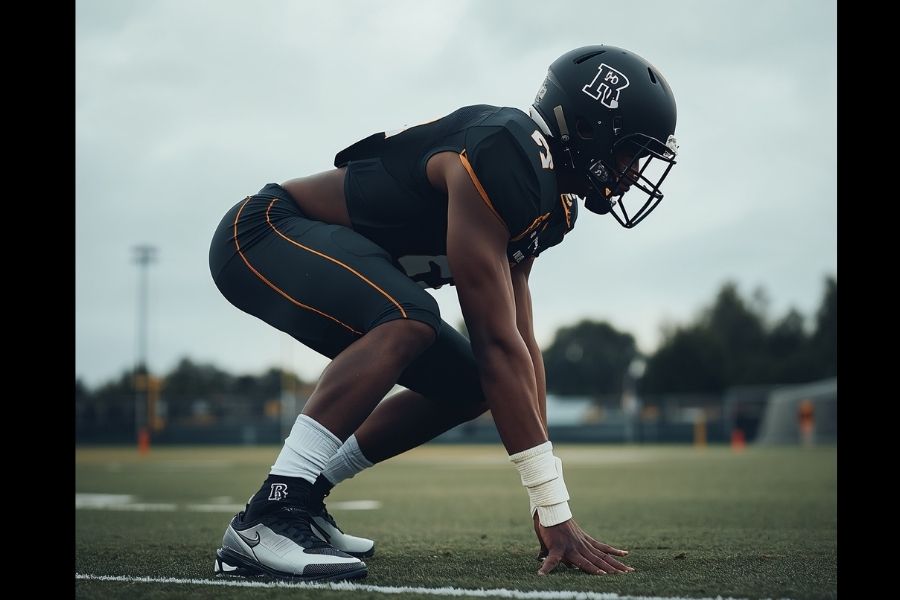
Place a cone directly on the line of scrimmage.
Start in your normal receiver stance.
Weight slightly forward.
Chest over knees.
Eyes focused downfield.
Hands relaxed.
Not tense.
Not rigid.
Ready.
How To Perform The Drill
1. Align at the cone.
2. Load weight onto the front portion of the lead foot.
3. On command, explode forward for five yards.
4. Keep pad level low through the first three steps.
5. Drive arms aggressively.
6. Finish through the cone.
7. Reset immediately.
8. Repeat for 3 sets of 6 reps.
Do not treat this as conditioning.
Treat every rep like a game snap.
The Coach’s Whistle
“Push the ground away!”
“Win the first three steps!”
“No false step!”
“Stay low!”
“Violent arms!”
Common Mistakes
Mistake 1: Standing Up Immediately
Young receivers often pop upright after the snap.
The result?
Lost acceleration.
Lost power.
Lost separation.
Fix
Keep your shoulders slightly over your knees through the first three steps.
Stay loaded.
Mistake 2: False Stepping
Many players step backward before moving forward.
That tiny mistake costs valuable time.
Fix
Apply pressure through the lead foot before movement begins.
Think push.
Not step.
Mistake 3: Weak Arm Action
Lazy arms create lazy acceleration.
Fix
Drive elbows aggressively from cheek to hip.
Solo Modification
Film yourself from the side.
Watch the first three steps.
If your head rises immediately or your first movement travels backward, fix it before adding speed.
Drill 2: Everyday Wall Ball (Hands & Focus)
Primary Focus
- Soft hands
- Reaction speed
- Ball tracking
- Catch consistency
This might be the most underrated drill in football.
It looks simple.
It is not.
Wall ball exposes every weakness in your catching mechanics.
Hard hands?
You’ll see it.
Poor focus?
You’ll see it.
Bad tracking?
You’ll see it.
Fast.
Setup
Equipment:
- Football
- Concrete wall
- Brick wall
- Rebound wall
Distance:
5 to 8 feet from wall
How To Perform The Drill
High Catch Series
Throw football high against the wall.
Catch with thumbs together.
Secure immediately.
Repeat 25 times.
Low Catch Series
Throw football below waist height.
Catch with pinkies together.
Secure immediately.
Repeat 25 times.
Left Side Series
Throw football toward the left shoulder.
Extend.
Catch.
Secure.
Repeat 25 times.
Right Side Series
Same process.
Repeat 25 times.
Total:
100 catches.
Every day.
The Coach’s Whistle
“Hands, not chest!”
“Soft fingers!”
“See it all the way!”
“Finish every catch!”
“Secure the football!”
Common Mistakes
Mistake 1: Body Catching
Many receivers allow the football to hit their chest.
That works until contact arrives.
Then drops happen.
Fix
Catch outside your frame.
Hands first.
Always.
Mistake 2: Hard Hands
Players often stab at the football.
The ball bounces away.
Fix
Receive the football.
Do not attack it.
Mistake 3: Watching The Catch Too Late
Eyes leave the ball too early.
Drops follow.
Fix
Track the football completely into the hands.
Solo Modification
Already a solo drill.
That is why elite receivers love it.
You need a football.
A wall.
And consistency.
Nothing else.
Drill 3: Pocket Catching Drill (Late Hands)
Primary Focus
- Pocket catching
- Ball security
- Late hands
- Route finishing
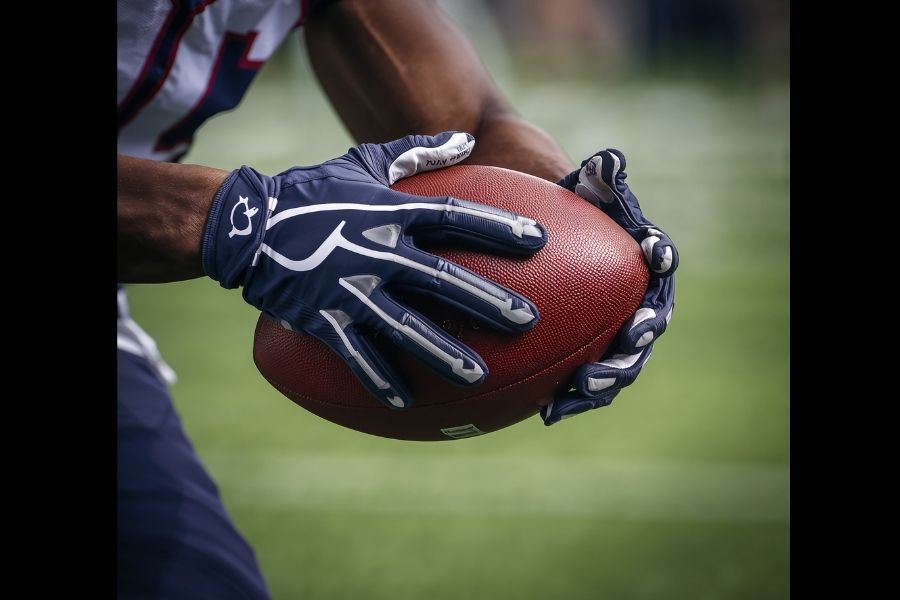
Many drops happen before the football arrives.
Why?
Because receivers reveal their hands too early.
Defensive backs see it.
Then attack.
Late hands eliminate that tell.
Setup
Equipment:
- Football
- Partner
- Coach
- JUGS machine
If no partner is available, use a rebound wall.
How To Perform The Drill
Catch footballs in multiple positions:
High Pocket
Above eye level.
Thumbs together.
Midline Pocket
Chest level.
Hands relaxed.
Low Pocket
Below waist.
Pinkies together.
Outside Frame
Extend fully.
Catch away from the body.
Back Shoulder
Open hips.
Track.
Secure.
Every catch finishes with:
Catch.
Tuck.
Rip.
Secure.
The Coach’s Whistle
“Late hands!”
“Strong through contact!”
“Frame the football!”
“Meet the ball!”
“Finish every catch!”
Common Mistakes
Mistake 1: Showing Hands Early
Corners read your hands.
Then attack the football.
Fix
Keep normal running mechanics until the football arrives.
Mistake 2: Clapping At The Ball
This causes bounce-outs.
Fix
Create a pocket.
Receive.
Do not clap.
Mistake 3: Weak Tuck
The catch is not complete until secured.
Fix
Catch.
Tuck.
Rip.
Every rep.
Solo Modification
Use a wall ball.
Alternate catch pockets:
- High
- Low
- Left
- Right
- Outside frame
Build hand discipline.
Drill 4: 3-Cone Line Drill
Primary Focus
- Linear acceleration
- Deceleration
- Route efficiency
- Change of direction
This drill develops route transitions.
Great receivers are not just fast.
They can stop.
Explode.
Stop again.
Explode again.
That is separation.
Setup
Equipment:
3 cones
Cone spacing:
5 yards apart.
Straight line.
Cone 1 → Cone 2 → Cone 3
How To Perform The Drill
1. Sprint from Cone 1 to Cone 2.
2. Touch line.
3. Accelerate to Cone 3.
4. Touch line.
5. Sprint back through Cone 1.
6. Repeat.
Focus on controlled deceleration.
Not sloppy stopping.
The Coach’s Whistle
“Drop your hips!”
“Stick the break!”
“Violent arms!”
“Explode out!”
“No drifting!”
Common Mistakes
Mistake 1: Standing Tall During Deceleration
High hips equal slow cuts.
Fix
Lower center of gravity before stopping.
Mistake 2: Too Many Choppy Steps
Young players take six or seven breakdown steps.
Fix
Control momentum efficiently.
Plant.
Drive.
Go.
Mistake 3: Rounded Direction Changes
Rounded cuts waste space.
Fix
Attack each cone directly.
Solo Modification
Set cones at a local field.
Time for every rep.
Track improvement weekly.
Drill 5: The “W” Drill
Primary Focus
- Deceleration
- Spatial awareness
- Route transitions
- Body control
The W Drill teaches receivers how to move through multiple route angles without losing balance.
This drill looks easy.
It isn’t.
By the final cone, poor body control becomes obvious.
Setup
Equipment:
5 cones
Arrange cones in a W pattern.
Each cone separated by approximately 5 yards.
How To Perform The Drill
1. Sprint to Cone 2.
2. Plant and redirect.
3. Sprint to Cone 3.
4. Plant and redirect.
5. Continue through the entire W pattern.
6. Maintain speed while controlling body position.
Every cut should be sharp.
Not rounded.
The Coach’s Whistle
“Sink your hips!”
“Drive off the plant foot!”
“No wasted steps!”
“Stay under control!”
“Win every angle!”
Common Mistakes
Mistake 1: Drifting Around Cones
Players run curves.
Not angles.
Fix
Attack the cone directly.
Cut sharply.
Mistake 2: Poor Foot Placement
Feet land outside the body frame.
Balance disappears.
Fix
Plant underneath hips.
Mistake 3: Upright Body Position
Tall players often stay too high.
Fix
Lower center of gravity entering every cut.
Solo Modification
Film from behind.
Watch route shape.
If cuts look rounded, slow down and rebuild technique.
Speed comes later.
How To Build A Weekly WR Training Program Schedule
Most receivers train randomly.
Monday looks different than Tuesday.
Wednesday is skipped.
Thursday becomes conditioning.
Then they wonder why progress stalls.
Structure wins.
Use this weekly framework
| Day | Primary Focus | Field Work |
| Monday | Acceleration | First-Step Explosion Drill, 3-Cone Line Drill |
| Tuesday | Hands | Wall Ball, Pocket Catching |
| Wednesday | Route Movement | W Drill, Break Mechanics |
| Thursday | Hands & Tracking | Wall Ball, Pocket Catching |
| Friday | Game Speed | All Drills Combined |
| Saturday | Competition | Routes vs Coverage |
| Sunday | Recovery | Mobility, Film Study |
Final Thoughts
The biggest mistake young receivers make is chasing complicated drills before mastering simple ones.
- Elite receivers are boring.
- That is why they are elite.
- They catch footballs every day.
- They work their first step every day.
- They sharpen their deceleration every day.
- They track football every day.
- Then, when the lights come on and the ball is in the air, the movement feels familiar.
- The defender sees talent.
- The receiver feels repetition.
- That is the difference.